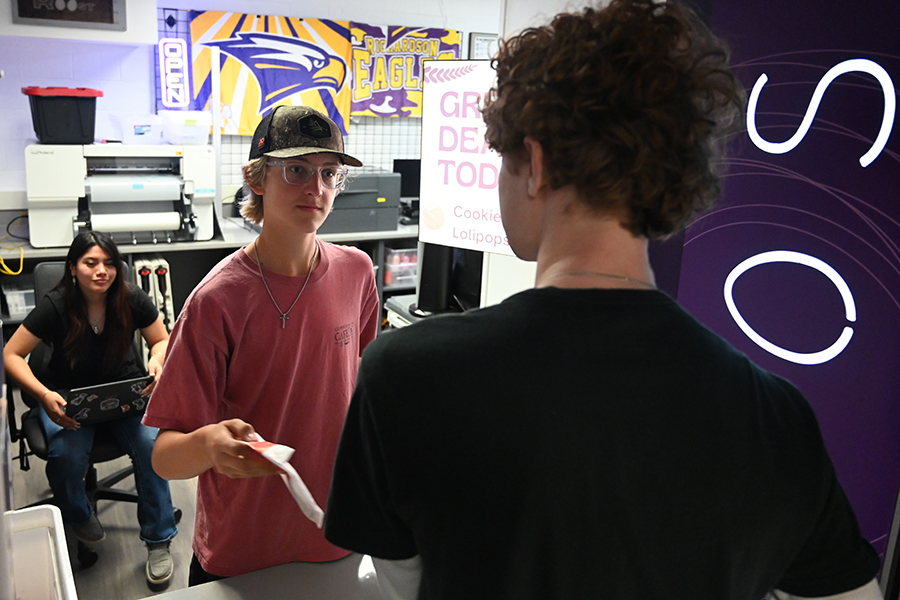
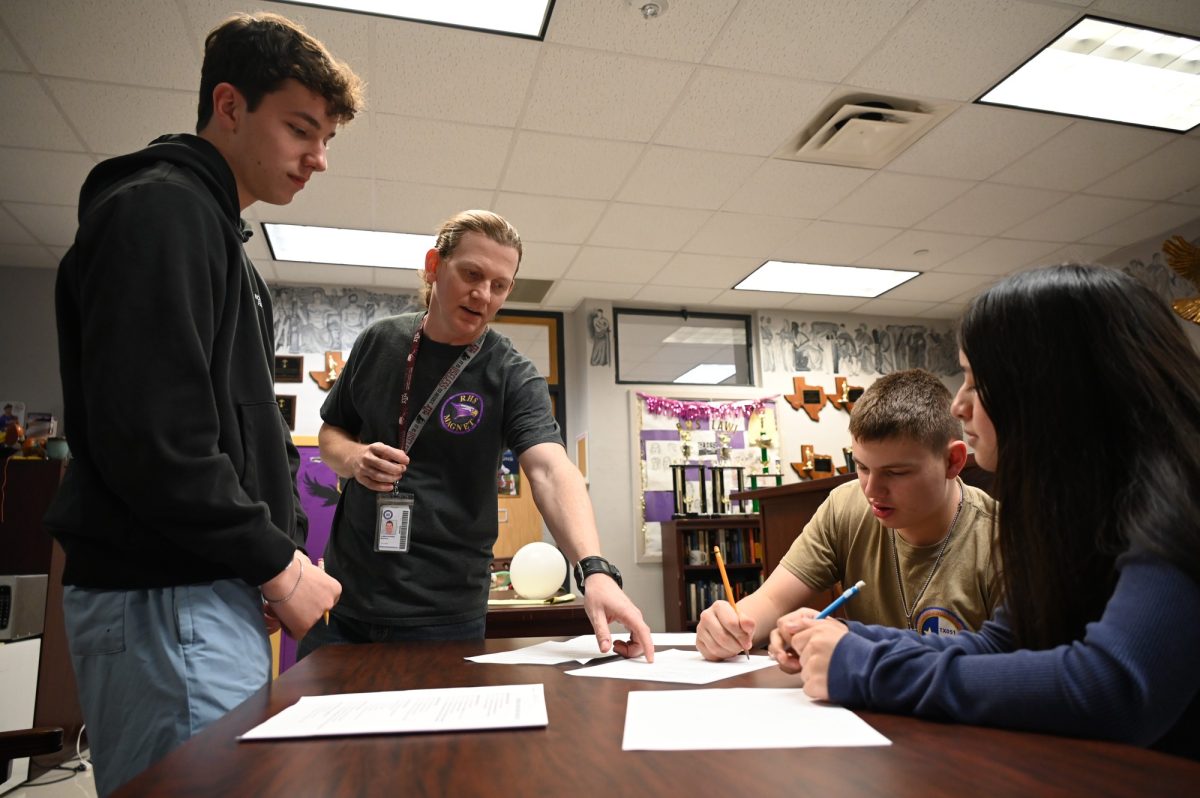
As soon as sophomores John Andrews and Aarav Patel sat down, Andrews opened the negotiation by offering to sell the “Thunder Lizard X9” car for $60,000. Patel shook his head and countered with $50,000, prompting Andrews to respond with $52,000. After several exchanges over the price, warranty and features, Andrews made a final offer: $52,000 with a six-month warranty and multiple features. When Patel asked whether the features were included in the price and Andrews said no, Patel stood up from his seat and declined to sign the contract.
After spending a semester learning about contract law, Law Magnet teacher Christopher Bufkin created a game for his sophomore magnet students to practice negotiation and to understand the steps involved in creating a contract.
The game consisted of four rounds, during which students negotiated the sale of widgets, a house, a car, and an emotional support dragon. They took turns being the buyer and seller and bargained over the price, quantity, accessories, warranties and payment plans for each of the products in order to reach a fair agreement.
Sophomore Ellenai Shewangizaw successfully settled two contracts on the house and the car. She said she felt like she got the better hand of both deals by selling the house for a higher amount than her minimum price and receiving a payment plan with a warranty on the car at a good price.
“I feel like I got what I needed and that was all that mattered,” Shewangizaw said.
She said for the widgets round, the seller was trying to ask for a higher price than what she wanted, so she ultimately decided not to go through with the contract.
“I realize that it’s far more beneficial for me to have no sale than have a really bad sale, so I was able to kind of withdraw when I needed to,” Shewangizaw said.
Andrews said he used the strategies and legal terms he learned in class to help him write a legal contract where they’re not committing any crimes.
“If we hadn’t actually had the contract with paper and we haven’t signed it, the contract wouldn’t have been valid,” Andrews said. “If it was just a handshake or something, that wouldn’t be valid.”
Shewangizaw said she used a checklist that had questions like, “Were you fair in your negotiations?” “Did you know your minimum?” and “Did you exceed your maximum?” to ensure both parties knew what they were signing into.
“We learned a lot of rules and things about what contracts need and what’s considered like a quote unquote legal contract,” Shewangizaw said.
Sophomore Arden Elder said that the game taught her how to negotiate different components of a contract and communicate what you want and need.
“You don’t have to settle for something, like you can fight for what you want,” Elder said.
Bufkin secretly designed one of the contracts to fail to show students that it’s ok when they can’t reach an agreement, and that they’re still successful because they learned something.
“The point of it is that it’s okay to walk away,” Bufkin said. “If you don’t feel like you can make that deal, walk away.”
Bufkin first introduced the game to his class during his second year at RHS when there were 50-minute classes. This year, he had to change the game and add more rounds and rules to fit his 90-minute class.
“I’ve been trying to think of a way to reincorporate that,” Bufkin said. “And I think this whole four-round thing would be a nice one that covers the class period and will be a lot of fun and interactive between them. And it also allows students who might not necessarily talk to each other.”
Bufkin said he used ChatGPT to help him adjust the game by asking it to come up with different scenarios and numbers. After it came up with ideas, Bufkin changed some of the numbers and added more terms so it fit his class.
“ChatGPT is a good tool to help build on ideas, and so that’s what I try to use it for,” Bufkin said. “I look for ideas through it, and then I make it what I need it to be. I’ll take the idea and make it better.”
He said he hopes his students become more confident in negotiations because it can be nerve-wracking. He hopes they know to walk away when they don’t feel comfortable going to their maximum price, even if it could settle a deal.
“There are a lot of areas in our life where we do have the power to negotiate – buying power,” Bufkin said. “A lot of students that when I talked [to them], they’re thinking that the seller has all the power, but they don’t have the money and they want the money. So the buyer does have power.”