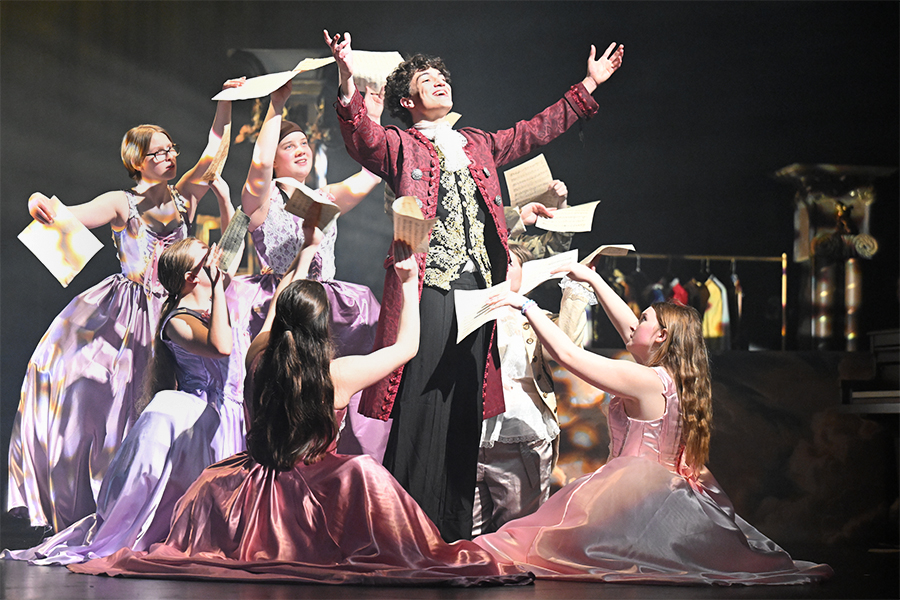
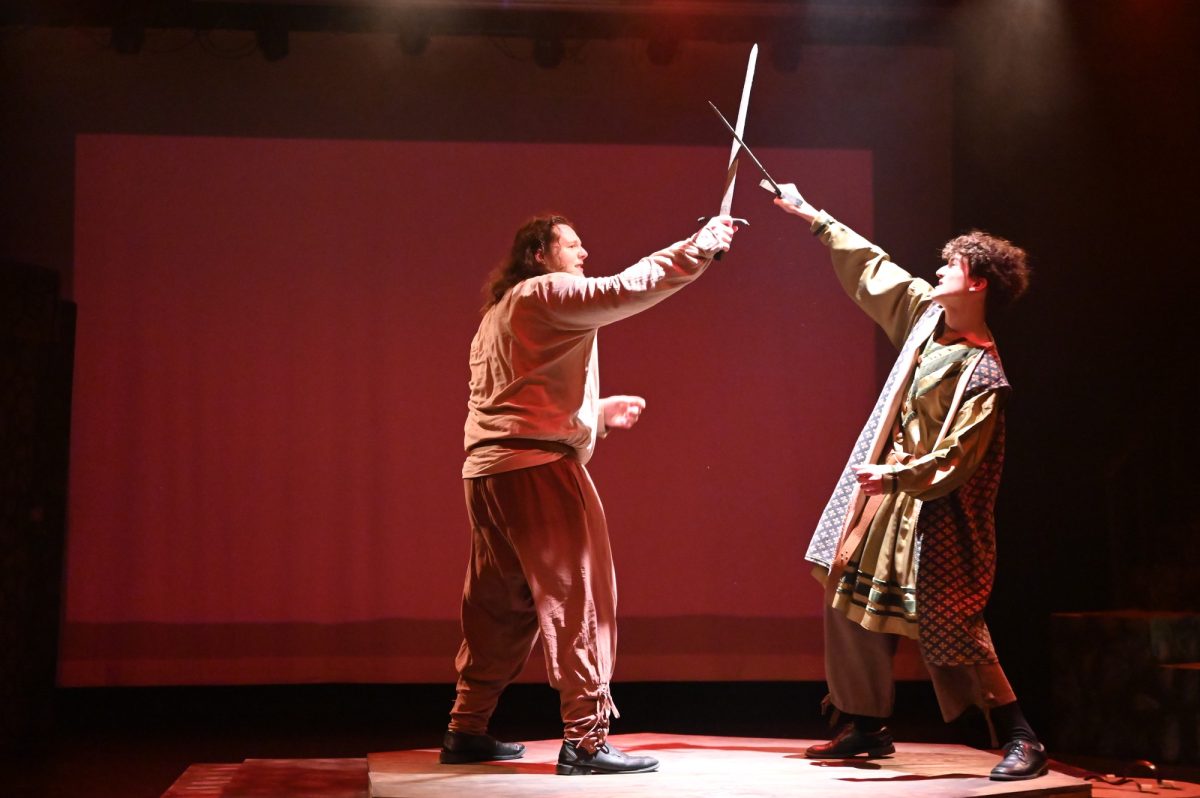
Junior Reiner Grantham who plays Macbeth, and sophomore Clay Morgan who plays Macduff, exchange quick slices of their blade as they jump from one platform to another. They finally drop their weapons only to start punching each other. During the fight, director Emily Whitman stood at the edge of the stage, calling out choreography counts and reminding students to keep their distance during rehearsal.
The Theatre Collective included stage combat for the first time in their Halloween production of “Macbeth”. The show ran from October 30 through November 1.
Whitman chose “Macbeth” for its battle-heavy scenes and cast students in roles that required both emotional intensity and physical coordination.
“They were all over the stage,” Whitman said. “Not only fighting with weapons, but also with their hands.”
Every student in the cast participated in at least one fight for practice. Whitman began rehearsals by teaching the basics of combat – sword positions, attacker and defender roles, and how to move safely. The defender controlled the motion of each sequence, leading the combat.
“We always start slow,” Whitman said. “Consent is key. The defender has to say ‘Yes, you can touch my arm, or yes, you can pull my shoulder.’”
The choreography was built around numbered positions, which students practiced repeatedly. Once they mastered the basics, they could mix up the order and adapt the fights to their characters’ motivations.
The fight between Macbeth and Macduff was choreographed to show both technique and emotion as fights were fueled by Macbeths rage and revenge.
“Macbeth had arranged to have Macduff’s entire team taken out,” Whitman explained. “So Macduff’s fight is personal.”
Students used shields, swords of varying lengths and physical combat to portray the intensity of revenge. Timing, reactions and stage blood helped make the violence look real.
“We had crossed swords and stage punches,” Holzwanger said. “It was a mix of sword fighting and physical combat, and it looked really good.”
To ensure safety, students used blunted swords and kept distance during hand-to-hand combat. Punches were replicated with sound effects called “naps” and reactions were timed to make the fights seem real. Rails were also added to the castle stairs to ensure no accidental falls, and students confirmed consent before each physical interaction.
“We wanted it close enough to look real, but far enough that no one was ever in danger,” Whitman said.
Whitman said the actors were eager to rehearse fight scenes even during breaks, embracing every challenge that came along.
“They always wanted to practice,” Whitman said. “I trusted they’d take care of each other and not get hurt.”
Junior Parker White, who played Ross, said adapting choreography to the stage layout was one of the biggest challenges.
“Even if we have all the stuff together, putting it all together is the hardest part,” White said.
White also made adjustments to herself to play a male character.
“I sort of make myself more spread out,” White said. “I try to keep my voice not too deep or too high.”
Freshman Rose Barron, who played one of the witches, prepared by watching “Hocus Pocus” once a week to study how witches move and speak.
Junior Olivia Holzwanger, who played Lady Macbeth, said maintaining emotional intensity throughout the show was the hardest part.
“Shakespeare’s pretty grueling work,” Holzwanger said. “Especially for a character like Lady Macbeth.”
To prepare, she watched the 1970 version of “Macbeth” starring Sir Laurence Olivier and wrote down all her lines. Her favorite moment was Lady Macbeth’s final scene, where she sleepwalks across the stage in a haunting display of unraveling guilt.
“I’m looking forward to my final scene,” Holzwanger said. “I sleepwalk and it’s really cool.”
The show was performed for English classes during the week of Halloween. Whitman said the theatre department often invites other classes when the material connects to their curriculum.
“If the show we’re doing is relevant to what’s being taught, we’ll invite those folks,” she said.
Some students were wary of the infamous “’Macbeth’ curse,” a theater superstition tied to the play’s use of witchcraft. Saying the name “Macbeth” in a theater not performing the show is believed to bring bad luck.
“Because of the witches in the show, most people believe it’s cursed,” Holzwanger said.
To break the curse, Holzwanger said you must either spin three times counterclockwise or spit over your shoulder.
Whitman said by the last rehearsal the performers made the combat feel real, not only because of practice but because they trusted each other.
“I think we did something people didn’t expect,” Barron said. “And that’s what makes it powerful.”